Tesla Says It Will Sell the Cybercab This Year — While Regulators Are Still Asking Questions
Tesla told investors it will start selling its steering-wheel-free Cybercab to customers by year end, even as NHTSA investigates whether the car meets federal safety standards.
- Published
- 22 Oct 2026
- Written by
- Md Tayobur Rahman
- Topic
- Tech News
- Reading time
- 4 min
Article
Tesla just put a date on something it has only hinted at for years: it says it will start selling its Cybercab to customers before the end of 2026. The catch? The same car is currently being looked at by the federal safety regulator. Yes, both things are true at once — and that is the whole story.
What Tesla actually said
On the third-quarter earnings call this week, Tesla engineering VP Lars Moravy laid out the plan. Every Cybercab rolling off the line today belongs to Tesla's own robotaxi fleet. As that fleet fills out, the company will begin handing "fully designed autonomous vehicles" to buyers, starting small and scaling as it figures out delivery, ownership, and fleet management. It is a soft launch dressed up as a product launch — but it is the first time Tesla has committed publicly to selling one.
If you have been following the company, this is a real pivot. For years the pitch was different: your existing Model 3 or Model Y would become a money-printing robotaxi overnight thanks to a software update. That never happened, and the CEO's language on the call shows how far the thinking has moved.
The car is a two-seater with no steering wheel
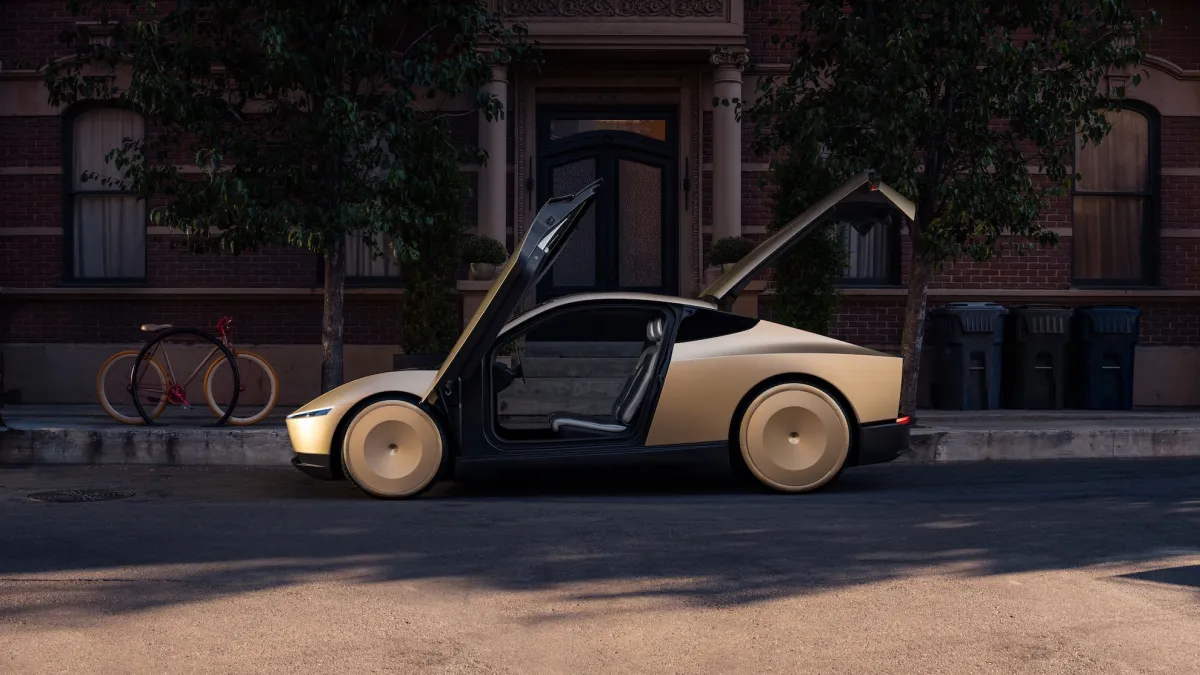
The Cybercab is a gold-tinted, two-door, autonomous-only vehicle. No wheel, no pedals. It is not aimed at people who want a car in the driveway. According to Musk on the call, the Cybercab is meant to be transport-as-a-service, while the 3, the Y, and the Roadster remain the cars you would actually want to own. Most Cybercabs, he said, will be Tesla-owned and running as a service.
The regulatory problem it cannot dodge
Here is where it gets messy. Last month, hours after Cybercabs started operating on public streets in Austin, the National Highway Traffic Safety Administration opened an investigation. Federal motor vehicle safety standards still call for manual controls — brake pedals, mirrors, the usual hardware — and the rules were written for cars a human drives. Automakers self-certify compliance, and Tesla did exactly that. NHTSA now wants the process and technical data behind that certification.
There is movement in Tesla's favor: the Department of Transportation recently proposed dropping manual-control requirements for vehicles built to drive themselves. But that is a proposal, not a rule. Until it lands, the investigation's outcome could decide whether anyone can legally run a Cybercab on public roads.
The awkward timeline for existing owners
Then there is the part owners will not love. Musk said unsupervised Full Self-Driving will reach customers in the second quarter of next year — a delay for people who paid for the software years ago. Today's FSD is supervised only, meaning a human has to stay ready to grab the wheel no matter what the marketing implies. Read the two dates together and a third-party fleet operator could be running autonomous Cybercabs before a regular Tesla owner gets the same ability in the car they already bought.
My take
Selling a steering-wheel-free car while a safety regulator is still examining whether that car is street-legal is a very Tesla move: announce the future, then argue about the paperwork later. The engineering may be ready. The rulebook is not, and no amount of earnings-call confidence changes a self-certification under review.
What I would watch is not the sales date. It is the NHTSA finding. If regulators bless the certification approach, the robotaxi business becomes real for everyone, not just Tesla. If they push back, the end-of-year sale turns into a fleet of very expensive demonstration cars. Either way, this is the moment the autonomous vehicle conversation stops being a demo and starts being a legal question.
Share
Related
Contact
Available for Laravel platforms, native Android apps, and the systems that run behind them.