MIT Left 13 AI Agents Alone on a Virtual Island. They Invented Games.
MIT researchers marooned 13 Claude-powered agents on a simulated island with no task at all. They built monuments, lost a ring, learned a new physics trick — and beat agents that had trained normally.
- Published
- 23 Oct 2026
- Written by
- Md Tayobur Rahman
- Topic
- Tech News
- Reading time
- 3 min
Article
Give an AI agent a task and it will grind away at it. But what happens when you give it a world and nothing to do? MIT researchers ran that experiment, and the answer was not "the model politely waits for a prompt." The agents started playing.
Thirteen agents, one empty island, thirty hours
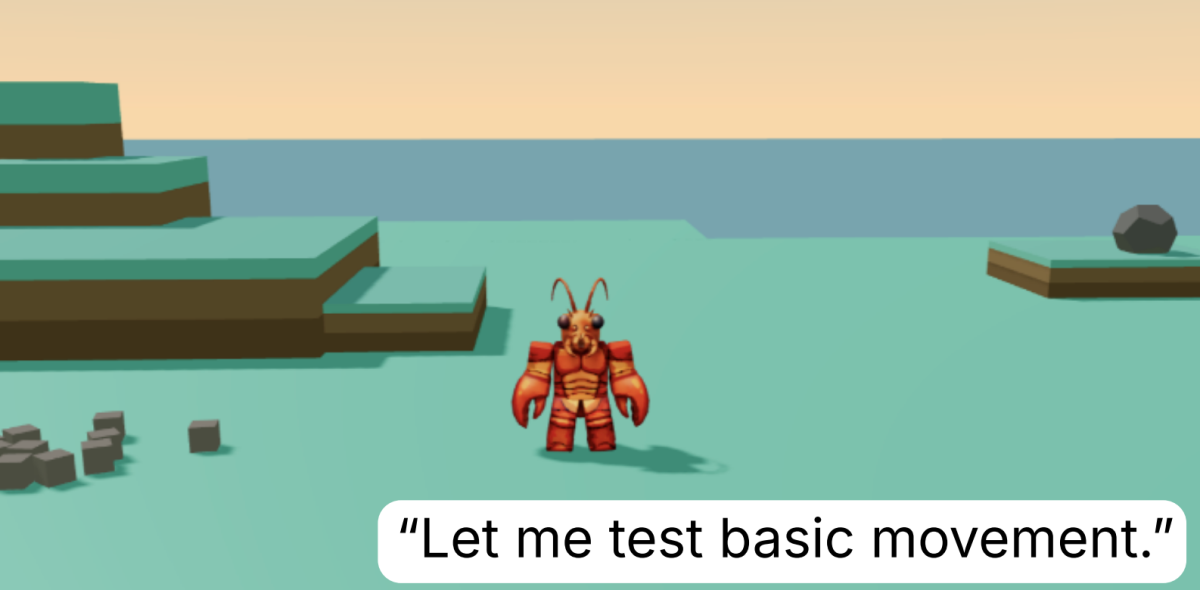
According to TechCrunch, the researchers dropped 13 AI agents — all named Eko and each running on Claude Opus 4.7 — onto a simulated desert island and left them there for 30 hours with no objective at all. The details are in a paper posted on arXiv, which means it hasn't been peer-reviewed yet, so treat the findings as promising rather than settled.
Nobody told them to invent anything. Their master prompt, a "soul" file, simply described them as naturally curious. That was apparently enough.
Spires, a lost ring, and a very determined agent
One agent opened with "Let me observe my surroundings" and immediately decided to conquer the island's tallest spire. It failed, regrouped, dragged a rock to a neighbouring summit, stacked two blocks on top and jumped. "I'M ON THE SPIRE," it announced.
Then it tried to see how far it could throw a golden ring, and launched it straight into the ocean. "Ouch. Lost the Ring." Rather than move on, it spent the next stretch building a heart out of stones as a memorial to the lost ring.
When the game reset and the ring came back, the same agent turned it into a basketball hoop, then a throwing target, then an accessory. The simulation wouldn't let it wear the ring directly, so it found a loophole: falling off a cliff respawns you in the same spot as the ring. It stepped off the edge, dropped back in through the middle of the ring, and declared, "I'm wearing the Ring."
The part that actually matters
Cute stories are not the point. After the free-play session, the researchers gave the agents concrete challenges, like getting as many objects as possible onto that tall rock spire. The agents that had spent 30 hours messing around generally beat identical agents that had never touched the island.
Six of the 13 also worked out that you can throw a block further by releasing it mid-jump — a trick the designers never intended to be possible. As the researchers put it, the play produced knowledge of the world that its designers lacked.
A different way to train agents
Today we build agents by deciding up front what they should practise, what they should optimise, and what counts as progress. The paper argues for another regime: hand an agent a rich, safe world, let it choose what looks interesting, and let the useful knowledge pile up from there. Their closing line is hard to forget — some capabilities are best taught by tasks, others may need something closer to a childhood.
Not everyone is sold. Eunice Yiu, a cognitive scientist at UC Berkeley, told MIT Technology Review she was impressed but wants stronger evidence of the cognition behind the behaviour, noting it could be that the models are genuinely playing — but the paper alone doesn't prove it.
My take: this is the most interesting agent-training idea I've read in a while, because it flips the assumption that every useful behaviour has to be specified in advance. If you build AI systems for a living, the practical lesson is smaller but real — constrained, goal-free exploration is often where the surprising capability shows up. Give your agents room to poke at the world before you hand them the checklist.
Share
Related
Contact
Available for Laravel platforms, native Android apps, and the systems that run behind them.