XDOF Nears a $1.2B Valuation Just Months Out of Stealth — Why Robot Data Is the Next Gold Rush
Three months out of stealth, robot-data startup XDOF is already chasing a $1.2B valuation. Here is why real-world training data has become the new bottleneck for robotics.
- Published
- 05 Sep 2026
- Written by
- Md Tayobur Rahman
- Topic
- Tech News
- Reading time
- 3 min
Article
Ever wonder why ChatGPT can write a novel but your robot vacuum still eats cables? Here's the short version: one of them got to learn from the entire internet, and the other had almost nothing to study. Real-world robot data is shockingly scarce — and a startup called XDOF just proved how valuable that scarcity really is.
A head-spinning raise
Less than three months after emerging from stealth, XDOF is already in late-stage talks to close a Series B at a valuation of roughly $1.2 billion, led by 8VC, according to TechCrunch. That lands right on top of a $70 million Series A it closed in June with backing from Thrive Capital, Andreessen Horowitz, Lux, and Spark Capital.
The company reportedly had no plans to raise again this quickly. But with annualized revenue approaching $50 million, investors came knocking anyway. When demand for what you're building outruns your own fundraising calendar, that's usually a healthy sign.
What XDOF actually does
XDOF builds the unglamorous but essential plumbing of robotics: data pipelines, collection tools, and annotation systems. The pitch is straightforward — frontier AI labs and robotics companies would rather not build this infrastructure themselves, so XDOF acts as an outsourced data supply chain for the whole industry.
Investors have started calling it "the Scale AI for physical robots," a nod to the data-labeling giants that helped fuel the LLM boom. The company was co-founded in 2024 by UC Berkeley researchers Philipp Wu (CEO) and Fred Shentu (CTO).
Why robot data is such a bottleneck
Large language models got a massive head start because they could train on, well, everything on the web. Physical robots have no equivalent. There's no giant open dataset of "how to fold a shirt" or "how to flatten a box." That gap is exactly where XDOF planted its flag.
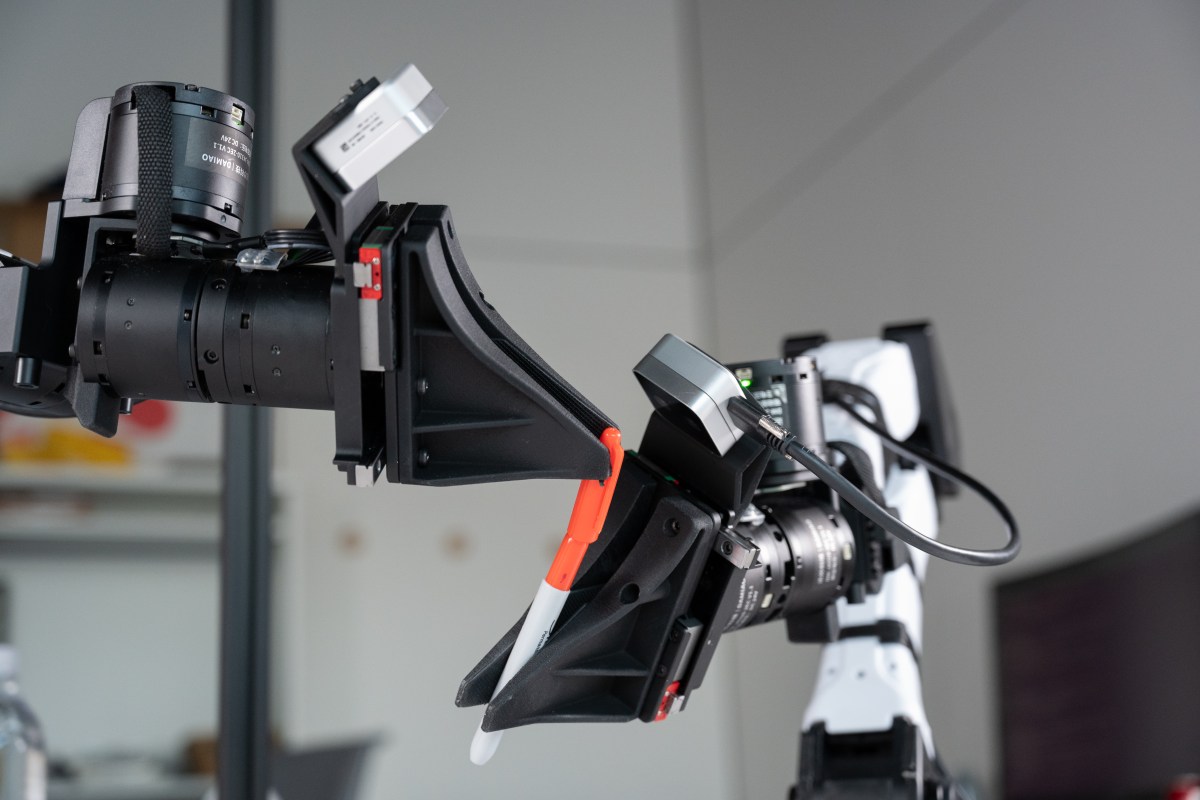
The company traces back to GELLO, a low-cost teleoperation system Wu and Shentu built that lets a human steer a robotic arm remotely to generate training data. That work became an influential robotics paper — and eventually, a company.
Where it's headed
XDOF is teaming up with UC Berkeley's AI Research lab to release a dataset it calls ABC, which it believes is the largest collection of high-quality robot training data ever assembled. To capture it, the company pairs remote teleoperation with human collectors who wear sensors while doing everyday tasks.
It's also planning to hire and train data collectors worldwide, and it says it's already working with 20 customers, including several frontier AI labs. Competition is heating up too — Mecka AI, Scale AI, and Micro1 are all chasing real-world robot data.
The takeaway? The AI boom taught us that whoever owns the best training data usually wins. XDOF's sudden rise is a bet that the same rule holds for robots — and that the data layer, not just the hardware, is where the real money will be made.
Share
Related
Contact
Available for Laravel platforms, native Android apps, and the systems that run behind them.